How AI Voice Agents Handle Appointment Scheduling, FAQs & Lead Qualification
Businesses today are expected to respond to customers quickly, provide accurate information, and make it easy for potential customers to take the next step. But when phone calls keep coming in, handling every conversation manually can become time-consuming and difficult to scale.
Customers may call to ask a simple question, schedule an appointment, check availability, request more information, or determine whether a business can help with a specific need. While these conversations may be important, they can also take employees away from other responsibilities.
This is where AI voice agents are becoming a practical solution for businesses.
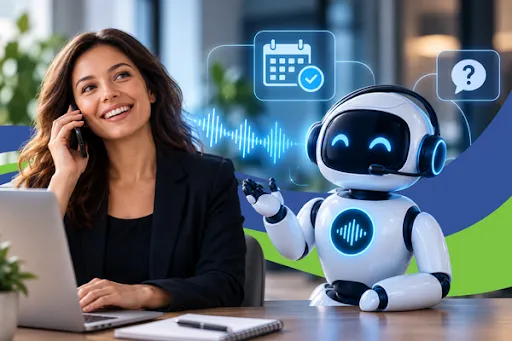
An AI voice agent can communicate with callers using natural language and help automate many common phone interactions. Depending on how it is configured, it can answer frequently asked questions, schedule appointments, collect information, qualify leads, and route more complex conversations to a human team member.
Instead of thinking of AI voice technology as simply an automated answering system, businesses can use it as part of a broader customer communication, lead generation, and business automation strategy.
What Is an AI Voice Agent?

An AI voice agent is an artificial intelligence-powered system that can communicate with customers through voice conversations.
Traditional automated phone systems often require callers to navigate menus by pressing numbers. For example:
"Press 1 for sales. Press 2 for customer service. Press 3 for billing."
An AI voice agent can take a more conversational approach.
A caller can explain what they need in their own words, and the AI can interpret the request and respond based on its instructions, knowledge, and connected business systems.
For example, a caller might say:
"Hi, I'm interested in your service. I'd like to know if you have any appointments available this week."
Instead of requiring the caller to navigate several menu options, the AI can recognize that the person is interested in a service and wants to schedule an appointment.
From there, it can continue the conversation and guide the caller toward the appropriate next step.
Depending on the business, an AI voice agent can be used to:
Answer incoming calls
Answer frequently asked questions
Provide business information
Schedule appointments
Reschedule or cancel appointments
Collect customer information
Qualify potential leads
Identify customer intent
Route calls to the appropriate employee
Capture information for follow-up
Support marketing and sales workflows
The specific capabilities depend on how the AI voice agent is configured and what systems it is connected to.
Why Are Businesses Using AI Voice Agents?
One of the biggest challenges businesses face is responding to customers quickly.
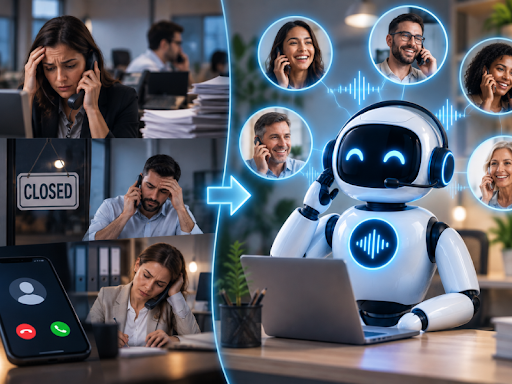
A potential customer may find a business online, visit its website, and decide to call. But if nobody answers, the opportunity may disappear.
The same issue can happen when:
Employees are already on other calls
The business is closed
The sales team is unavailable
Call volume suddenly increases
Employees are busy with customers
Staff members are handling repetitive administrative tasks
This creates a gap between customer interest and business availability.
AI voice agents can help close that gap by providing an automated first point of contact.
Instead of immediately sending callers to voicemail, an AI voice agent can engage with them, understand what they need, and help move the conversation forward.
For businesses that depend heavily on phone calls, this can be particularly valuable.
How AI Voice Agents Handle Appointment Scheduling
One of the most common applications of AI voice technology is appointment scheduling.
Scheduling may sound simple, but it can create a significant amount of repetitive work for employees.
A customer calls.
An employee answers.
The employee asks what the customer needs.
The employee checks availability.
The employee discusses dates and times.
The appointment is booked.
Then another customer calls and the process starts again.
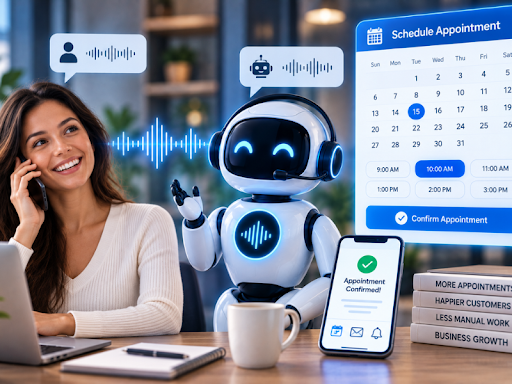
An AI appointment scheduling agent can automate much of this process when connected to the appropriate calendar or scheduling system.
Step 1: The AI Answers the Call
When the customer calls, the AI voice agent can answer and determine why the person is calling.
For example:
"I'd like to schedule a consultation."
The AI recognizes the customer's intent and begins the scheduling conversation.
Step 2: The AI Understands What the Customer Needs
Before booking an appointment, the AI may need additional information.
Depending on the business, it could ask:
What service are you interested in?
Are you a new or existing customer?
What type of appointment do you need?
What day works best for you?
Do you have a preferred time?
Is there anything specific you'd like the team to know?
These questions help make sure the appointment is appropriate and that the business receives the information it needs.
Step 3: The AI Checks Availability
When integrated with a scheduling system, the AI can help identify available appointment times.
Instead of asking customers to repeatedly call back or wait for an employee, the AI can guide them through the available options.
Step 4: The Customer Selects a Time
The caller can choose the appointment time that works best for them.
The AI can then confirm the details before completing the scheduling process.
Step 5: The Appointment Is Confirmed
The AI can confirm relevant information such as:
Customer name
Appointment type
Date
Time
Contact information
Depending on the business's setup, the appointment can then trigger additional confirmation or follow-up processes.
Appointment Scheduling Doesn't Have to Stop at the First Booking
AI voice agents can also be configured to assist with certain scheduling changes.
For example, a customer may call and say:
"I can't make my appointment tomorrow. Can I move it to next week?"
Instead of requiring an employee to manually manage the request, the AI can help determine the customer's needs and guide them through the available options.
This can reduce repetitive scheduling work while making the process easier for customers.
How AI Voice Agents Answer FAQs
Another major use case for AI voice agents is automated FAQ management.
Almost every business has questions that customers ask repeatedly.
For example:
What are your business hours?
Where are you located?
What services do you offer?
Do I need an appointment?
What areas do you serve?
How does the process work?
What should I bring?
How can I get started?
Do you offer consultations?
Employees may spend hours answering these questions over the phone, even though the answers are relatively straightforward.
An AI voice agent can be configured to answer these frequently asked questions using approved business information.
AI FAQs Can Create a More Convenient Customer Experience
Imagine someone discovers your business online at 8:30 PM.
They have a question and decide to call.
Instead of immediately reaching voicemail, they can interact with an AI voice agent that provides the appropriate information.
The conversation could then continue naturally.
The caller might ask about your services.
The AI answers.
The caller becomes interested.
The AI asks whether they would like to schedule an appointment.
The customer books a consultation.
A simple FAQ interaction can therefore become the beginning of a potential customer relationship.
How AI Voice Agents Handle Lead Qualification
For businesses focused on sales and growth, AI lead qualification can be another important application.
Not every caller has the same level of buying intent.
Some people are simply researching.
Some want pricing information.
Some are comparing different providers.
Others are ready to speak with someone or schedule an appointment.
A sales team can spend a lot of time manually determining which leads are worth following up with first.
AI voice agents can help by asking predefined qualification questions during the conversation.
What Is Lead Qualification?
Lead qualification is the process of determining whether a potential customer is a good fit for a business's products or services.
The qualification criteria will vary depending on the company.
An AI voice agent might ask questions such as:
What service are you interested in?
What problem are you trying to solve?
When are you looking to get started?
What type of project do you have?
Have you worked with a provider before?
What is the best way for our team to contact you?
The purpose isn't to interrogate the caller.
The goal is to gather useful information that helps determine the appropriate next step.
From Phone Call to Qualified Lead
Consider a potential customer who calls a business after seeing an advertisement online.
The caller says they are interested in a particular service.
The AI voice agent can:
1. Identify the caller's interest
The AI determines what product or service the person is asking about.
2. Answer initial questions
The AI provides relevant information based on the company's approved knowledge.
3. Ask qualification questions
The AI gathers information about the customer's needs, timeline, or other relevant criteria.
4. Determine the next step
Depending on the responses, the AI may offer an appointment, collect contact information, or route the caller to a team member.
5. Capture the information
The caller's information can be passed into the appropriate CRM or business workflow when integrations are available.
This creates a more organized process for handling inbound leads.
AI Voice Agents Can Connect FAQs, Scheduling, and Lead Qualification
The most powerful use of an AI voice agent isn't necessarily any single feature.
It's the ability to connect multiple steps together.
A customer may not call specifically to become a qualified lead.
They might simply have a question.
But that conversation can develop naturally.
For example:
Customer calls
↓
AI answers the phone
↓
Customer asks a question
↓
AI answers the FAQ
↓
Customer expresses interest
↓
AI asks qualifying questions
↓
Lead is identified
↓
AI offers an appointment
↓
Customer schedules a consultation
↓
Information is captured for follow-up
This is where AI voice automation can become part of a larger marketing and sales workflow.
The phone call isn't just a customer service interaction anymore.
It can become an opportunity to guide the customer toward the next appropriate step.
What Happens When a Human Needs to Step In?
AI shouldn't be expected to handle every conversation.
There are situations where human involvement is necessary.
A caller may have:
A complicated question
A complaint
A sensitive situation
A request outside the AI's knowledge
A situation requiring professional judgment
A problem that needs a specific employee
This is why human handoff should be part of the AI voice strategy.
When the AI recognizes that a conversation requires human assistance, it can follow the business's predefined escalation process.
Depending on the setup, that could mean transferring the caller to an employee or collecting the information needed for someone to follow up.
The goal is not:
AI replaces humans.
The goal is:
AI handles appropriate routine interactions so humans can focus on conversations where their expertise matters.
Benefits of AI Voice Agents for Businesses
When implemented correctly, AI voice agents can support several areas of business operations.
Faster Customer Response
Customers don't always want to wait for someone to become available.
AI voice agents can respond immediately to incoming calls and begin helping the customer.
Fewer Missed Opportunities
When a business can't answer every call, potential leads can be lost.
AI can provide an additional layer of coverage for incoming conversations.
Less Repetitive Work
Employees don't have to manually answer every basic question or handle every routine scheduling request.
Improved Lead Capture
Instead of simply missing a call, the business can potentially collect important information from the caller.
More Efficient Appointment Management
Automating parts of the appointment process can reduce the administrative workload associated with scheduling.
Better Customer Convenience
Customers can communicate with a business through a conversational phone experience instead of navigating complicated menus or waiting for a callback.
How AI Voice Agents Fit Into a Larger Business Automation Strategy
The phone should not operate separately from the rest of a company's marketing and sales systems.
When an AI voice agent is connected to other business tools, the information gathered during a conversation can potentially trigger additional actions.
For example:
Inbound Call
→ AI Voice Agent
→ Customer Intent
→ FAQ Answer
→ Lead Qualification
→ Appointment Booking
→ CRM Update
→ Follow-Up
→ Sales Team Notification
This creates a connected workflow rather than a collection of disconnected tools.
For businesses investing in AI automation, this type of integration can help connect customer conversations with the systems already being used to manage leads and customers.
Best Practices for Implementing an AI Voice Agent
AI voice technology works best when businesses start with a clear strategy.
1. Identify Repetitive Conversations
Start by identifying the calls your employees handle repeatedly.
Which questions come up every day?
Which calls take up the most time?
Which conversations follow a predictable process?
These may be strong candidates for automation.
2. Build a Reliable Knowledge Base
Your AI needs accurate business information.
This can include:
Services
Business hours
Locations
Policies
Appointment rules
Frequently asked questions
Service areas
Contact information
The quality of the AI's responses depends heavily on the information and instructions it receives.
3. Define Lead Qualification Criteria
Determine what makes someone a qualified lead before building the qualification flow.
The AI should ask questions that actually help your business make decisions.
4. Create Clear Human Handoff Rules
Decide when the AI should stop handling the conversation and involve a human.
This helps prevent the AI from attempting to handle situations it isn't designed for.
5. Review and Improve
AI voice automation should be treated as an ongoing process.
Businesses can review conversations and outcomes to identify areas that need improvement.
Over time, you may discover new FAQs, better qualification questions, or additional tasks that can be automated.
Is an AI Voice Agent Right for Your Business?
AI voice agents aren't necessarily the right solution for every company.
However, they may be particularly useful for businesses that:
Receive a high volume of inbound calls
Depend on phone leads
Schedule appointments
Answer repetitive customer questions
Experience missed calls
Have a structured lead qualification process
Want to improve response times
Need additional support outside normal business hours
The important question isn't simply whether your business should use AI.
The better question is:
Where could AI make the customer experience and internal workflow more efficient?
That could be answering FAQs.
It could be appointment scheduling.
It could be lead qualification.
Or it could be a combination of all three.
Start With One Problem
Businesses don't need to automate their entire phone system at once.
In fact, starting small can make it easier to determine where AI provides the most value.
You might begin with:
Step 1: FAQ automation
Then expand into:
Step 2: Appointment scheduling
And eventually:
Step 3: Lead qualification and CRM integration
As these capabilities work together, they can become part of a larger customer communication system.
The objective isn't to add AI simply because AI is trending.
The objective is to solve real business problems.
The Future of AI Voice Agents in Business
The role of AI voice agents is expanding beyond traditional automated phone systems.
Businesses can increasingly use voice AI to connect conversations with their broader customer journey.
Instead of:
Customer calls → Employee answers
Businesses can create workflows such as:
Customer calls → AI understands intent → AI answers questions → AI qualifies the lead → AI schedules an appointment → Information is captured → Human team follows up when necessary
This approach can make phone communication more scalable while still keeping human interaction where it matters.
The businesses that benefit most from voice AI won't necessarily be the ones that automate the most.
They will be the ones that automate the right conversations.
Final Thoughts
AI voice agents are changing how businesses manage phone conversations.
From appointment scheduling and FAQ automation to lead qualification and customer follow-up, voice AI can help businesses create a more efficient way to manage inbound communication.
The biggest opportunity isn't simply having an AI answer the phone.
It's creating a system where each conversation has a clear purpose and next step.
A customer can get an answer.
A prospect can become a qualified lead.
An appointment can be scheduled.
Information can be captured.
And when a situation requires human expertise, the conversation can be passed to the right person.
That combination of AI automation and human support can help businesses create a more responsive customer experience without requiring employees to manually handle every routine interaction.
Ready to Explore AI Voice for Your Business?
If your business relies on phone calls to generate leads, answer customer questions, or schedule appointments, it may be worth taking a closer look at where AI voice automation could fit into your workflow.
Start by looking at your current process.
How many calls are missed?
How many questions does your team answer repeatedly?
How much time is spent scheduling appointments?
How quickly are new leads qualified?
And how many opportunities could potentially be lost simply because someone wasn't available to answer the phone?
These questions can help you identify where voice AI could make the biggest difference.
MarketingROI.ai helps businesses explore how AI and automation can support marketing, lead generation, customer communication, and business growth.
With the right strategy, an AI voice agent can become more than an automated receptionist. It can become part of a connected customer journey that helps move people from first conversation to qualified opportunity, appointment, and follow-up.
See What Voice AI Can Do for Your Business
Explore how AI-powered voice agents can help your business handle customer conversations, automate appointment scheduling, answer FAQs, and qualify leads.
👉 Explore Voice AI with MarketingROI.ai:
MarketingROI.ai Voice AI
Looking for more ways to use AI and automation to improve your marketing and business processes?
👉 Visit MarketingROI.ai:
MarketingROI.ai
Your customers are already calling. The opportunity is making every conversation count.
