How Google Ads Works in 2026: A Beginner’s Guide to Paid Search
If you've ever searched for a product or service on Google and noticed sponsored results appearing above the organic listings, you've seen Google Ads in action.
Google Ads is one of the most widely used forms of paid search advertising. It allows businesses to reach potential customers when they are actively searching for products, services, answers, or solutions.
But how does Google decide which ads appear? How much does an advertiser pay? And does the business that bids the most automatically get the top position?
Not necessarily.
Google Ads uses an auction system that considers factors such as your bid, ad relevance, expected performance, landing page experience, and other signals.
Understanding how this process works can help businesses spend their advertising budgets more strategically and generate more valuable leads and sales.
Here's a beginner-friendly look at how Google Ads works in 2026.
What Is Google Ads?
Google Ads is Google's advertising platform that allows businesses to promote their products and services across Google's search results and other properties.
For paid search, advertisers typically create ads that can appear when someone searches for terms related to their business.
For example, imagine someone searches:
"emergency plumber near me"
A plumbing company could create a Google Search ad targeting searches related to emergency plumbing services.
The business isn't simply paying Google to show the ad to everyone.
Instead, Google determines when and where the ad may appear based on the user's search, advertiser settings, competition, bids, relevance, and other factors.
This makes Google Ads particularly valuable because businesses can reach people who may already have commercial intent.
How Does the Google Ads Auction Work?
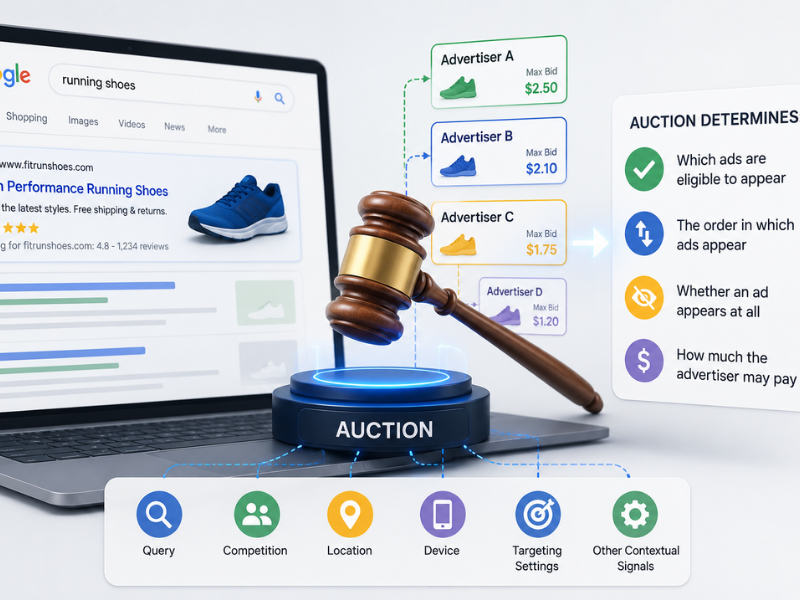
One of the most important things to understand about Google Ads is that every search can trigger an auction.
When someone performs a search that could be relevant to an advertiser's targeting, Google evaluates eligible ads.
The auction determines:
• Which ads are eligible to appear
• The order in which ads appear
• Whether an ad appears at all
• How much the advertiser may pay
The auction happens in real time.
This means the results can change from one search to another depending on factors such as the query, competition, location, device, targeting settings, and other contextual signals.
Does the Highest Bid Always Win?
No.
A higher bid can help an advertiser compete, but Google Ads isn't simply a highest-bid-wins system.
Google also considers the expected usefulness and quality of the ad experience.
This is why an advertiser with a lower bid can sometimes achieve a better position than a competitor with a higher bid.
What Determines Google Ads Ad Rank?
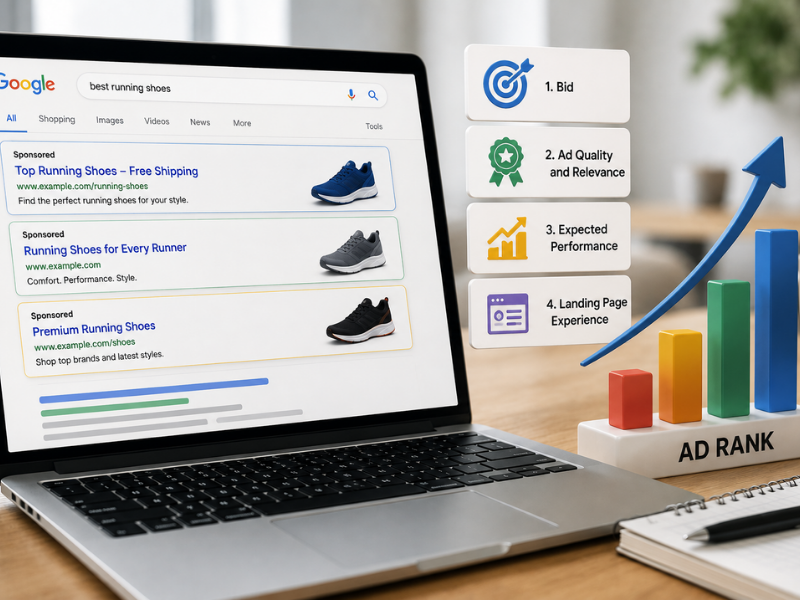
A major concept in Google Ads is Ad Rank.
Ad Rank helps determine whether an ad is eligible to show and where it may appear relative to other eligible ads.
While Google's systems are complex and can change over time, advertisers should generally think about Ad Rank as being influenced by factors including:
1. Your Bid
Your bid represents how much you're willing to pay for a particular advertising opportunity.
Depending on your campaign and bidding strategy, Google may use automated systems to adjust bids with the goal of achieving a particular advertising objective.
However, simply increasing your bid isn't always the best solution.
If your ads generate poor results, spending more can simply mean spending your budget faster.
2. Ad Quality and Relevance
Google wants users to see advertisements that are useful for their searches.
Your ad should therefore closely connect with what the person is looking for.
For example, if someone searches for "commercial roof repair," an ad specifically focused on commercial roof repair is generally more relevant than a generic advertisement for a roofing company.
Relevance can influence the overall performance of your advertising.
3. Expected Performance
Google considers signals related to how likely an ad is to perform.
Factors can include the expected click-through rate and the relevance of the ad to the user's search.
This means advertisers should focus on creating ads that genuinely match user intent rather than simply trying to attract as many clicks as possible.
4. Landing Page Experience
Getting someone to click your ad is only part of the process.

What happens after the click matters too.
Your landing page should:
• Match the promise made in the ad
• Clearly explain the offer
• Load efficiently
• Be easy to navigate
• Work well on mobile devices
• Make it easy for visitors to take the desired action
For example, if your ad promotes "24/7 emergency HVAC repair," the landing page should immediately communicate that service rather than sending visitors to a generic homepage.
How Keywords Work in Google Ads
Keywords are another fundamental part of paid search advertising.
A keyword represents a search-related concept that advertisers can use to help identify the searches they want their ads associated with.
For example, a digital marketing agency might target keywords related to:
• digital marketing agency
• SEO services
• local SEO services
• Google Ads management
• PPC management
However, modern Google Ads isn't simply about matching an exact keyword to an exact search.
Google considers the meaning and intent behind searches and uses its matching systems to determine when ads may be eligible to appear.
That's why search intent is just as important as keyword selection.
Understanding Search Intent
Search intent refers to what a person is actually trying to accomplish with their search.
Consider these three searches:
Informational Intent
"How does Google Ads work?"
The person is looking for information.
Commercial Intent
"Best Google Ads agency for small business"
The person may be researching potential providers.
Transactional Intent
"Hire Google Ads management agency"
The person is much closer to taking action.
Understanding these differences helps advertisers create campaigns and landing pages that better match where potential customers are in the buying journey.
Google Ads Match Types
Google Ads provides keyword match options that help advertisers control how closely search queries need to relate to their selected keywords.
The primary keyword match types include:
Broad Match
Broad match provides wider reach and allows Google's systems to identify searches that may be related to the keyword's meaning.
It can help advertisers discover new searches and reach a broader audience.
However, businesses should monitor search terms and conversion performance carefully.
Phrase Match
Phrase match provides more control while still allowing Google to match searches with variations that relate to the meaning of the keyword.
Exact Match
Exact match provides greater control over the searches an advertiser wants to target, although it does not necessarily mean only one identical search phrase can trigger the ad.
The right match type depends on the campaign's goals, budget, conversion data, and desired level of control.
How Google Ads Bidding Works
Google Ads requires advertisers to compete for available advertising opportunities through bidding.
There are several ways advertisers can approach bidding.
Some businesses prefer more manual control, while others use Google's automated bidding systems to optimize toward specific goals.
Common objectives can include:
• Increasing website traffic
• Generating leads
• Increasing conversions
• Increasing conversion value
• Improving return on ad spend
The most important point is that your bidding strategy should match your business objective.
For example, if your primary goal is qualified leads, optimizing solely for clicks may not be the best approach.
You want your campaign to focus on the actions that actually contribute to business growth.
Why Conversion Tracking Matters
One of the biggest mistakes beginners make with Google Ads is focusing exclusively on clicks.
A click isn't necessarily a customer.
Imagine two campaigns:
Campaign A
1,000 clicks
10 leads
Campaign B
400 clicks
40 leads
Campaign B generated fewer clicks but significantly more leads.
That's why conversion tracking is essential.
Conversions can include actions such as:
• Form submissions
• Phone calls
• Purchases
• Appointment bookings
• Quote requests
• Sign-ups
• Downloads
By tracking meaningful conversions, businesses can better understand which campaigns, keywords, ads, and audiences are contributing to actual business outcomes.
Google Ads Cost: How Much Do You Pay?
There isn't one universal price for Google Ads.
The amount you pay can vary based on factors such as:
• Industry
• Competition
• Keywords
• Location
• Audience
• Campaign settings
• Ad quality
• Bidding strategy
• Market demand
Many Search campaigns use a cost-per-click (CPC) model, meaning advertisers can pay when someone clicks their ad.
But the actual cost isn't necessarily equal to the advertiser's maximum bid.
Google's auction determines the price based on the circumstances of that particular advertising opportunity.
This is another reason why simply setting the highest possible bid isn't necessarily the smartest strategy.
Google Ads Targeting
Google Ads allows advertisers to control who they want to reach and where their ads can appear.
Depending on the campaign, targeting can involve factors such as:
Location
Businesses can target specific geographic areas.
For example:
• United States
• California
• Phoenix
• Specific cities
• Service areas
This is particularly important for local businesses.
A local dentist doesn't necessarily need to advertise to people hundreds of miles away.
Language
Advertisers can configure language-related targeting based on their campaign strategy and audience.
Devices
Campaign performance can vary between:
• Desktop
• Mobile
• Tablet
Understanding device behavior can help advertisers determine where their budget is producing the strongest results.
Audiences
Audience signals and targeting options can help businesses reach people based on relevant characteristics and behaviors.
The exact options available can depend on the campaign type and Google's current advertising capabilities.
Why Ad Relevance Matters
Imagine searching for:
"affordable accounting services for small businesses"
You see two advertisements.
Ad A: "Accounting Services"
Ad B: "Affordable Accounting Services for Small Businesses"
Ad B immediately appears more closely connected to the search.
That alignment can improve the user's experience and potentially improve advertising performance.
The goal shouldn't be to manipulate Google's system.
Instead, advertisers should focus on answering the user's search as clearly and directly as possible.
Your Landing Page Can Make or Break Your Campaign
Even a highly relevant advertisement can produce disappointing results if the landing page isn't effective.
Suppose your ad promises:
"Free Roofing Inspection – Schedule Today"
But the visitor lands on a homepage where they have to search through multiple pages to find the inspection offer.
You may lose the lead.
A strong landing page should make the next step obvious.
Consider including:
• A clear headline
• A concise value proposition
• Supporting information
• Trust signals
• Testimonials or reviews where appropriate
• A strong call to action
• A simple contact form or booking process
The goal is to reduce friction between the ad click and the desired conversion.
Google Ads vs. Organic Search
Google Ads and SEO can both help businesses appear in search results, but they work differently.
Google Ads:
• Paid advertising
• Can generate traffic quickly
• Requires an advertising budget
• Ads appear in designated paid placements
• Performance can be measured through campaign data
SEO:
• Organic visibility
• Usually takes longer to build
• Requires ongoing optimization and content
• Pages appear in organic results
• Performance can be measured through organic traffic and conversions
For many businesses, the strongest search strategy isn't choosing one over the other.
It's using paid search and SEO together.
Google Ads can help capture demand now, while SEO can build long-term organic visibility.
How to Improve Google Ads Performance in 2026
If you're just getting started, don't try to optimize everything at once.
Focus on the fundamentals.
1. Define Your Goal
Decide what success means before launching your campaign.
Is it:
• Leads?
• Sales?
• Phone calls?
• Appointments?
• Revenue?
Your goal should guide your campaign setup.
2. Research Your Keywords
Look for keywords that align with your products, services, and customer intent.
Don't automatically target every keyword related to your industry.
Focus on searches that are commercially meaningful.
3. Write Relevant Ads
Your ad should directly address the user's search.
Include your key selling point and make the desired next step clear.
4. Build Relevant Landing Pages
Don't send every visitor to your homepage.
Whenever possible, create landing experiences that closely match the ad and search intent.
5. Track Conversions
Make sure you know what happens after someone clicks.
Without reliable conversion tracking, it becomes much harder to determine whether your advertising budget is producing business results.
6. Analyze the Data
Look beyond clicks.
Pay attention to metrics such as:
• Conversion rate
• Cost per conversion
• Conversion volume
• Conversion value
• Return on ad spend
• Search terms
• Ad performance
7. Continuously Optimize
Google Ads isn't necessarily a "set it and forget it" marketing channel.
Campaigns should be reviewed regularly and adjusted based on performance data.
Common Google Ads Mistakes Beginners Make
Choosing Keywords Without Considering Intent
A keyword may generate significant search volume but still produce poor-quality leads.
Always ask:
"What is this person trying to accomplish?"
Focusing Only on Clicks
Traffic isn't the same as revenue.
A campaign that generates fewer clicks but more qualified customers can be far more valuable.
Sending Every Visitor to the Homepage
Your landing page should support the specific search and advertisement.
Ignoring Conversion Tracking
Without conversion tracking, you're missing one of the most important pieces of the performance puzzle.
Increasing the Budget to Fix Poor Performance
More budget doesn't automatically fix an ineffective campaign.
Before increasing spending, investigate whether the issue is related to:
• Targeting
• Keywords
• Ad relevance
• Landing page experience
• Conversion tracking
• Offer
• Lead quality
Is Google Ads Worth It in 2026?
For many businesses, Google Ads can be an effective way to reach potential customers who are actively searching for their products or services.
But success isn't guaranteed simply because you launch a campaign.
The businesses that get the most value from paid search typically focus on the entire customer journey:
Search → Ad → Landing Page → Conversion → Customer
Optimizing only the advertisement isn't enough.
You need to understand what happens at every stage.
That's where marketing performance data becomes particularly important.
The Future of Google Ads Is More Data-Driven
Google Ads continues to evolve toward increasingly automated advertising systems.
That means advertisers need to think beyond individual keywords and bids.
Successful paid search strategies increasingly depend on:
• Strong conversion tracking
• High-quality business data
• Clear campaign goals
• Relevant landing pages
• Useful creative
• Accurate measurement
• Continuous optimization
Automation can help manage campaigns, but businesses still need to understand what they're trying to accomplish and how to measure success.
How MarketingROI.ai Can Help
Running Google Ads is only one part of the marketing equation.
The bigger question is:
"Is your marketing actually generating a return?"
MarketingROI.ai can help businesses think beyond vanity metrics and focus on marketing performance, ROI, and the relationship between marketing activity and business results.
Instead of looking only at clicks or impressions, a data-driven approach can help you better understand which marketing efforts are contributing to leads, customers, and revenue.
Ready to Look Beyond Clicks and Measure What Matters?
Explore MarketingROI.ai and take a more ROI-focused approach to your marketing.
Visit https://marketingroiai.com/ to learn more.
Final Thoughts
Google Ads can seem complicated when you're first getting started, but the basic concept is straightforward.
When someone searches Google, an auction determines which eligible ads can appear. Advertisers compete through bidding, while factors such as relevance, expected performance, landing page experience, and other signals influence how ads perform.
The goal isn't simply to get the most clicks.
The goal is to turn the right searches into valuable business outcomes.
By choosing relevant keywords, matching ads to search intent, creating strong landing pages, tracking conversions, and consistently analyzing performance, businesses can build a more effective paid search strategy in 2026.
And most importantly, don't stop at asking "How many clicks did we get?"
Ask:
"What did those clicks actually produce?"
That is where marketing ROI becomes the bigger picture.
